At the conclusion of my talk, a youth minister from a small church in the area approached me for advice on how to deal with a perplexing pastoral situation he was facing. A young girl in his youth group had recently decided she wanted to become a boy. My usual reaction to a conundrum like this would be to advise the girl of what the Bible teaches about how God created us as male and female, how Christians must embrace what God made us to be, and how God has a design for her life as a female. But there was more to this young girl's story than a spontaneous desire to change genders. There was an additional detail that would turn my usual response on its head.
This particular girl had been born with a rare biological condition that made it difficult at birth to determine whether she was a girl or a boy. The condition is known as "intersex," and intersexed persons are born with reproductive or sexual anatomy that doesn't seem to fit the typical pattern for female or male. Until relatively recently, the most common medical treatment for intersex has been for doctors to recommend a gender, to encourage the parents to embrace that gender, to surgically reshape the genitals and reproductive organs accordingly, and to advise parents not to express any ambiguity to the child about their selected gender. The young woman in question had undergone such surgery as an infant but now as a teen felt she wasn't really a girl after all. She felt her parents had made the wrong choice about what sex she was, and now she was in the midst of an identity crisis. She wanted to become what she felt she was born to be. She wanted to be a boy.
So the youth minister asked me, "What should I say to them? How do I minister to this student and her family?" I confess I was at a bit of a loss to answer his question. Not because I didn't know what the Bible teaches, but because I didn't know what intersex was. As I struggled to apply Scripture to a condition I'd never even heard of, it occurred to me that at the heart of this minister's query was a question about sex—not sex narrowly conceived as sexual acts, but more broadly conceived as gender and sexuality. At the root of his difficulty was a desire to know how the Bible's normative teaching about manhood and womanhood speaks to this difficult situation.
Showing posts with label Bible. Show all posts
Showing posts with label Bible. Show all posts
Wednesday, November 13, 2013
Issue of gender and gender confusion - responding pastorally.
The linked post highlights the need for Christians to recover their voice not only on the nature of marriage but also gender. Gender in today's culture is viewed as a personal choice rather something given by God, wired into our genes. This post doesn't answer the question as much as point out the unusual questions poised by issues in our culture and challenges the church to come up with compassionate responses based on truth found in the Scriptures.


Friday, November 8, 2013
Boys and young men doing poorly? Look to fathers and the ultimate Father.
Here's an interesting opinion piece in the Star Tribune by Kay Hymowitz of the Manhattan Institute. She points out the growing concern with the poor outcomes afflicting boys.
When I started following the research on child well-being about two decades ago, the focus was almost always girls’ problems — low self-esteem, lax ambitions, eating disorders and high rates of teen pregnancy.At the end she points out this problem is more than just a political question.
Now, though, with teen births down more than 50 percent from their 1991 peak and girls dominating classrooms and graduation ceremonies, boys and men are increasingly the ones under examination. Their high school grades and college attendance rates have remained stalled for decades. Among poor and working-class boys, the chances of climbing out of the low-end labor market — and of becoming reliable husbands and fathers — are looking worse and worse.
This spring, MIT economist David Autor and coauthor Melanie Wasserman suggested a reason for this: the growing number of fatherless homes. Boys and young men weren’t behaving rationally, they suggested, because their family situations had left them without the necessary attitudes and skills to adapt to changing social and economic conditions. Anyone interested in the plight of poor and working-class men — and, more broadly, mobility and the American dream — should hope this research, and the considerable biological and psychological evidence behind it, become part of the public debate.
But the truth is, we don’t know for sure what will help. It just may be that boys growing up where fathers — and men more generally — appear superfluous confront an existential problem: Where do I fit in? Who needs me, anyway? Boys see that men have become extras in the lives of many families and communities, and it can’t help but depress their aspirations. Solving that problem will take something much bigger than a good literacy program.I think a good place to look for wisdom is the Bible and the prophet Malachi who addressed a crisis facing ancient Israel in exile. He talked about God sending another prophet like Elijah who would "restore the hearts of the fathers to their children and the hearts of the children to their fathers, so that I will not come and smite the land with a curse." Malachi 4:5-6. Turning back to God and fathers is essential for restoring boys and young men.
Thursday, October 3, 2013
Dennis Prager takes on Richard Dawkins and the atheist illusion that God isn't necessary for morality.
Dennis Prager cuts through the argument made by atheist scientist Richard Dawkins that things would be just fine without God, e.g. the world would continue to operate morally without the existence of God.
This past Friday CNN conducted an interview with Richard Dawkins, the British biologist most widely known for his polemics against religion and on behalf of atheism.
Asked "whether an absence of religion would leave us without a moral compass," Dawkins responded: "The very idea that we get a moral compass from religion is horrible."
This is the crux of the issue for Dawkins and other anti-religion activists -- that not only do we not need religion or God for morality, but we would have a considerably more moral world without them.
This argument is so wrong -- both rationally and empirically - that its appeal can only be explained by a) a desire to believe it and b) an ignorance of history.
First, the rational argument.
If there is no God, the labels "good" and "evil" are merely opinions. They are substitutes for "I like it" and "I don't like it." They are not objective realities.
Every atheist philosopher I have debated has acknowledged this. For example, at Oxford University I debated Professor Jonathan Glover, the British philosopher and ethicist, who said: "Dennis started by saying that I hadn't denied his central contention that if there isn't a God, there is only subjective morality. And that's absolutely true."
And the eminent Princeton philosopher Richard Rorty admitted that for secular liberals such as himself, "there is no answer to the question, 'Why not be cruel?'"
Atheists like Dawkins who refuse to acknowledge that without God there are only opinions about good and evil are not being intellectually honest.
None of this means that only believers in God can be good or that atheists cannot be good. There are bad believers and there are good atheists. But this fact is irrelevant to whether good and evil are real.
To put this as clearly as possible: If there is no God who says, "Do not murder," murder is not wrong.
Many people or societies may agree that it is wrong. But so what? Morality does not derive from the opinion of the masses. If it did, then apartheid was right; murdering Jews in Nazi Germany was right; the history of slavery throughout the world was right; and clitoridectomies and honor killings are right in various Muslims societies.
So, then, without God, why is murder wrong?
Is it, as Dawkins argues, because reason says so?
My reason says murder is wrong, just as Dawkins's reason does. But, again, so what? The pre-Christian Germanic tribes of Europe regarded the Church's teaching that murder was wrong as preposterous. They reasoned that killing innocent people was acceptable and normal because the strong should do whatever they wanted.
In addition, reason alone without God is pretty weak in leading to moral behavior. When self-interest and reason collide, reason usually loses. That's why we have the word "rationalize" -- to use reason to argue for what is wrong....
But if that isn't enough, how about the record of the godless 20th century, the cruelest, bloodiest, most murderous century on record? Every genocide of the last century -- except for the Turkish mass murder of the Armenians and the Pakistani mass murder of Hindus in East Pakistan (now Bangladesh) was committed by a secular anti-Jewish and anti-Christian regime. And as the two exceptions were Muslim, they are not relevant to my argument. I am arguing for the God and Bible of Judeo-Christian religions.
Perhaps the most powerful proof of the moral decay that follows the death of God is the Western university and its secular intellectuals. Their moral record has been loathsome. Nowhere were Stalin and Mao as venerated as they were at the most anti-religious and secular institutions in Western society, the universities.
Strong words. But the implications of failing to confront these atheist illusions are frightening. Just look at the 20th century gulags and killing fields.
Most people aren't atheists. People have the innate sense that there is a God who created them and the universe. The frightening thing is far too many people are functionally atheists. Meaning they live as if there is no God. They make up the rules as they go along (At least they think they can.) and believe they are the final arbiter of right and wrong. That's a frightening notion as well.
Monday, September 9, 2013
Atheist professors, Christians, faith, logic and God's grace.
It goes without saying that universities are populated with very liberal professors extremely hostile to Christianity. How should, can a 18 year old freshman student who is a believer in Christianity and the Bible make it through a university education?
Here's an interesting blog post which addresses this question.
Here's an interesting blog post which addresses this question.
For one the writer says logic is on the side of Christians. For instance, the usual lines of attack against Christians are somewhat predictable.
"I'm a liberal, pacifist, atheist, and if you don't like it, you can leave," the professor said as he began the first day of Renaissance history at the University of Colorado. Joni Raille, who grew up in a conservative Christian home, was taken aback and wondered what her professor's bluntness had to do with Renaissance history. I asked her if she ever considered dropping the course. "No," she replied, "I can learn from anybody, even if he is an atheist." A few days later, Joni's professor began speaking of religious changes within European Christian culture. He wrote a Bible verse from the Gospel of Matthew on the board. "How many of you are Christians? Raise your hand!" Joni felt singled out. But she, along with four other students, raised their hands. The professor probed further. "How many of you read the Bible everyday? Keep your hand up." Joni kept her hand up. She was the only one. "What, are you going to be a nun or something?" Joni smiled, and politely said, "No." The professor smiled back. "C'mon Joni, I think you would look good wearing a religious habit like a nun." Not being equipped to confront these attacks cause many Christian kids to abandon their faith.The attacks and goals of undermining faith in God are quite deliberate by some.
Some parents who raised their sons and daughters in the church fear that their student will leave the faith while in college. There is some reason for their fear. As Cathy Lynn Grossman wrote,
Seven in ten Protestants ages 18 to 30—both evangelical and mainline—who went to church regularly in high school said they quit attending by age 23, according to the survey by LifeWay Research. And 34 percent of those said they had not returned, even sporadically, by age 30. That means about one in four Protestant young people have left the church.
Bill Savage, distinguished senior lecturer in English at Northwestern University, sees no problem with students walking away from their narrow-minded faith. Savage wrote,
For the foreseeable future, loyal ditto-heads [conservative parents] will continue to drop off their children at the dorms. After a teary-eyed hug, mom and dad will drive their SUVs off toward the nearest gas station, leaving their beloved progeny behind.
And then they all are mine.
And as the late Princeton philosopher Richard Rorty said, "We try to arrange things so that students who enter as bigoted, homophobic, religious fundamentalists will leave college with views more like our own."What are Christian kids to do? For one, realize logic and truth are on the side of a Christian worldview.
Stephen Guise left the small, evangelical Johnson Bible College in Tennessee to attend the University of North Carolina, Charlotte, to study business. He was required to take Philosophy 101. Stephen says that having a foundation of logical principles and Bible doctrine before entering the course helped him maintain his faith. The professor often played a Socratic role and allowed the students to discuss among themselves the issue of whether truth is relative or absolute. "The class was always exciting," Stephen recalled. "I was the only outspoken believer in God, and so it required a little courage to speak up." Stephen questioned his teacher, "Your statement, professor—'There is no absolute truth'—is that statement absolutely true?"
Many students find they don't need to get into heated argument or even say much at all in defense of their faith. They merely apply the law of non-contradiction to criticism. Sometimes they ask a simple question of clarification. An agnostic professor might say, "When it comes to matters of faith or God, you can't be certain about anything." A student like Stephen may think, Are you certain about that? A professor of sociology will say, "The religious must accept the reality and goodness of gay marriage, because we can't tolerate a lack of tolerance." A student who knows the logical principle of non-contradiction may ask, "Why are you being so intolerant of intolerance?" An atheistic lecturer may say, "You should reject belief in God, because you can't know anything is true unless it is scientifically verifiable, tested, and proven." But has her theory been verified, tested, or proven? Was it proven in the lab? If so, when? Where is the data? Because if this professor's statement is correct that her theory (which is really a philosophy) has been proven in the lab—scientifically verified and tested—then why should we believe it is true?
C. S. Lewis was convinced that reason is on the side of Christianity. In his classic fictional work The Screwtape Letters, he describes a veteran, experienced demon named Screwtape who advises a young, naive demon named Wormwood on how to keep his patient (a Christian) out of God's (the Enemy's) hand:Yet logic alone isn't enough. Here's a great quote by Chesterton.
Jargon, not argument, is your best ally in keeping him from the Church. Don't waste time trying to make him think that materialism is true! Make him think it is strong, or stark, or courageous—that it is the philosophy of the future . . . .The trouble about argument is that it moves the whole struggle on to the Enemy's (God's) own ground. He can argue too. . . . By the very act of arguing, you awake the patient's reason; and once it is awake, who can foresee the result?
Logic is a friend to people of faith and can be an aid for students to maintain their faith. But it is not the only factor in maintaining religious convictions. Joni, whom I mentioned earlier, was convinced that the grace of God preserved her relationship with Jesus. "In so many ways," she said, "I really don't know how I got out of college in one piece." For Joni, her "logic flowed from her faith." She cited G. K. Chesterton: "You can only find truth with logic if you have already found truth without it."I'm convinced we all exercise, place our faith in something. Whether you're a Christian or not. The question is what will one put their faith in and will it be the truth. Christianity has nothing to fear from rigorous intellectual debate. The Bible which is a written account of truth has survived many an attack over the years yet it hasn't been discredited in the least. I think that's because it is truth.
Young believers who persevere in orthodox or traditional Christianity love God with all their intellect but also with all their heart and strength as they love their neighbors as themselves. The inward witness of the Holy Spirit convicts them of the reality of God when life gets difficult. Logic and reason are tools that can certainly help prevent our sons and daughters from leaving the faith. But the most important means of preventing your child from leaving the faith is pointing them to spiritual conviction of Christ's grace.
Thursday, September 5, 2013
The Bible and Americans.
The American Bible Society did a survey of Americans and their view of the Bible. They found 88% of American households own a Bible.
While an amazing 88 percent of the nation’s homes own a Bible, more and more are switching to the internet, cell phones and iPad for their weekly inspiration, according to a sweeping new survey of Bible use.
In their latest survey of Bible use, the American Bible Society finds that 41 percent of Americans used the internet to read the good book on a computer. Some 29 percent said they searched Bible verses on a cell phone and 17 percent said they read an electronic version of the Bible on a Kindle or iPad.The Bible influences people's political beliefs. 69% say their personal faith influences their political beliefs. A scary thought I'm sure for the ACLU and Americans United for the Separation of Church and State.
The trend is similar in the news business, with the readers shifting to digital over paper.
“The data shows a continual shift to digital content. The number of Bible readers who use their smart phone or cell phone to search for Bible content has increased each year, with a 6 percent increase in the use of this format from 2012,” said the Society. “Use of internet to find Bible content has also increased, up 4 percent from 2011,” they added.
And, said the survey of 2,083, the most read and searched version of the Bible was the King James version. Thirty-eight percent preferred that over the New King James version, which just 14 percent prefer.
Americans also said that the Bible is king over the Koran, with 80 percent calling the Bible sacred, with just 8 percent citing the Koran. That was followed by the Torah, at 4 percent, and Book of Mormon at 3 percent.
With more people tapping into the Bible for direction and inspiration, the most read book in the world is also having a bigger influence in American politics. More than two-thirds, or 69 percent, said their personal faith has at least a little influence in political issues. And the percentage of those who said their faith influences their political leanings has increased from 27 percent last year to 31 percent this year.77% of Americans believe morality is on decline in America and 33% blame it on lack of Bible reading. 66% believe the Bible should be taught in the public schools. Interestingly 54% say the Bible and politics don't mix though above 69% say their faith influences their political beliefs.
-- 77 percent believe that morality in America is on the decline, with a third blaming the lack of bible reading.
-- 66 percent believing teaching the Bible in public schools is important.
-- 54% of adults agreed with the statement, "the Bible and politics do not mix."
-- 22% of adults believe the Bible should be taken literally, word for word
Thursday, August 22, 2013
Defense of the use of the Bible in public schools.
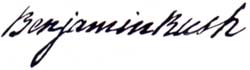
Here's a defense for using the Bible in the public schools made by a leading light in the American independence movement over 200 years ago. Benjamin Rush was a signer of the Declaration for Independence, a physician and close personal friend of the leading founders. He helped restore the friendship between Jefferson and Adams after years of estrangement.
As the for the Bible and its importance, here's what he had to say in a pamphlet entitled, "A Defense in the Use of the Bible in Schools. He wrote it in 1791.
As the for the Bible and its importance, here's what he had to say in a pamphlet entitled, "A Defense in the Use of the Bible in Schools. He wrote it in 1791.
Dear Sir:
It is now several months since I promised to give you my reasons for preferring the Bible as a schoolbook to all other compositions. Before I state my arguments, I shall assume the five following propositions:
I . That Christianity is the only true and perfect religion; and that in proportion as mankind adopt its principles and obey its precepts they will be wise and happy.My arguments in favor of the use of the Bible as a schoolbook are founded.
2. That a better knowledge of this religion is to be acquired by reading the Bible than in any other way.
3. That the Bible contains more knowledge necessary to man in his present state than any other book in the world.
4. That knowledge is most durable, and religious instruction most useful, when imparted in early life.
5. That the Bible, when not read in schools, is seldom read in any subsequent period of life.
I. In the constitution of the human mind.
1. The memory is the first faculty which opens in the minds of children. Of how much consequence, then, must it be to impress it with the great truths of Christianity, before it is preoccupied with less interesting subjects.
2. There is a peculiar aptitude in the minds of children for religious knowledge. I have constantly found them, in the first six or seven years of their lives, more inquisitive upon religious subjects than upon any others. And an ingenious instructor of youth has informed me that he has found young children more capable of receiving just ideas upon the most difficult tenets of religion than upon the most simple branches of human knowledge. It would be strange if it were otherwise, for God creates all His means to suit His ends. There must, of course, be a fitness between the human mind and the truths which are essential to its happiness.
3. The influence of early impressions is very great upon subsequent life; and in a world where false prejudices do so much mischief, it would discover great weakness not to oppose them by such as are true. I grant that many men have rejected the impressions derived from the Bible; but how much soever these impressions may have been despised, I believe no man was ever early instructed in the truths of the Bible without having been made wiser or better by the early operation of these impressions upon his mind. Every just principle that is to be found in the writings of Voltaire is borrowed from the Bible; and the morality of Deists, which has been so much admired and praised where it has existed, has been, I believe, in most cases, the effect of habits produced by early instruction in the principles of Christianity.
4. We are subject, by a general law of our natures, to what is called habit. Now, if the study of the Scriptures be necessary to our happiness at any time of our life, the sooner we begin to read them, the more we shall probably be attached to them; for it is peculiar to all the acts of habit, to become easy, strong, and agreeable by repetition.
5. It is a law in our natures that we remember longest the knowledge we acquire by the greatest number of our senses. Now, a knowledge of the contents of the Bible is acquired in school by the aid of the eye and the ear, for children, after getting their lessons, read or repeat them to their instructors in an audible voice; of course, there is a presumption that this knowledge will be retained much longer than if it had been acquired in any other way.
6. The interesting events and characters recorded and described in the Old and New Testaments are calculated, above all others, to seize upon all the faculties of the mind of children. The understanding, the memory, the imagination, the passions, and the moral powers are all occasionally addressed by the various incidents which are contained in those divine books, insomuch that not to be delighted with them is to be devoid of every principle of pleasure that exists in a sound mind.
7. There is in man a native preference of truth to fiction. Lord Shaftesbury says that "truth is so congenial to our mind that we love even the shadow of it"; and Horace, in his rules for composing an epic poem, established the same law in our natures by advising that "fictions in poetry should resemble truth." Now, the Bible contains more truth than any other book in the world; so true is the testimony that it bears of God in His works of creation, providence, and redemption that it is called truth itself, by way of preeminence above other things that are acknowledged to be true. How forcibly are we struck with the evidence of truth in the history of the Jews, above what we discover in the history of other nations. Where do we find a hero or an historian record his own faults or vices except in the Old Testament? Indeed, my friend, from some accounts which I have read of the American Revolution, I begin to grown skeptical to all history except that which is contained in the Bible. Now, if this book be known to contain nothing but what is materially true, the mind will naturally acquire a love for it from this circumstance; and from this affection for the truths of the Bible, it will acquire a discernment of truth in other books, and a preference of it in all the transactions of life.
8. There is wonderful property in the memory which enables it in old age to recover the knowledge acquired in early life after it had been apparently forgotten for forty or fifty years. Of how much consequence, then, must it be to fill the mind with that species of knowledge in childhood and youth which, when recalled in the decline of life, will support the soul under the infirmities of age and smooth the avenues of approaching death. The Bible is the only book which is capable of affording this support to old age; and it is for this reason that we find it resorted to with so much diligence and pleasure by such old people as have read it in early life. I can recollect many instances of this kind in persons who discovered no special attachment to the Bible in the meridian of their days, who have, notwithstanding, spent the evening of life in reading no other book. The late Sir John Pringle, physician to the queen of Great Britain, after passing a long life in camps and at court, closed it by studying the Scriptures. So anxious was he to increase his knowledge in them that he wrote to Dr. Michaelis, a learned professor of divinity in Germany, for an explanation of a difficult text of Scripture a short time before his death.
II. My second argument in favor of the use of the Bible in schools is founded upon an implied command of God and upon the practice of several of the wisest nations of the world.
In the sixth chapter of Deuteronomy, we find the following words, which are directly to my purpose: "And thou shalt love the Lord thy God with all thine heart, and with all thy soul, and with all thy might. And these words, which I command thee this day, shall be in thine heart: And thou shalt teach them diligently unto thy children, and shalt talk of them when thou sittest in thine house, and when thou walkest by the way, and when thou liest down, and when thou risest up."
It appears, moreover, from the history of the Jews, that they flourished as a nation in proportion as they honored and read the books of Moses, which contained the only revelation that God had made to the world. The law was not only neglected, but lost, during the general profligacy of manner which accompanied the long and wicked reign of Manasseh. But the discovery of it amid the rubbish of the temple by Josiah and its subsequent general use were followed by a return of national virtue and prosperity. We read further of the wonderful effects which the reading of the law by Ezra, after his return from his captivity in Babylon, had upon the Jews. They showed the sincerity of their repentance by their general reformation.
The learning of the Jews, for many years, consisted in a knowledge of the Scriptures. These were the textbooks of all the instruction that was given in the schools of their Prophets. It was by means of this general knowledge of their law that those Jews who wandered from Judea into other countries carried with them and propagated certain ideas of the true God among all the civilized nations upon the face of the earth. And it was from the attachment they retained to the Old Testament that they procured a translation of it into the Greek language, after they had lost the Hebrew tongue by their long absence from their native country. The utility of this translation, commonly called the Septuagint, in facilitating the progress of the Gospel is well known to all who are acquainted with the history of the first age of the Christian church.
But the benefits of an early and general acquaintance with the Bible were not confined to the Jewish nation; they have appeared in many countries in Europe since the Reformation. The industry and habits of order which distinguish many of the German nations are derived from their early instruction in the principles of Christianity by means of the Bible. In Scotland and in parts of New England, where the Bible has been long used as a schoolbook, the inhabitants are among the most enlightened in religions and science, the most strict in morals, and the most intelligent in human affairs of any people whose history has come to my knowledge upon the surface of the globe.
I wish to be excused from repeating here that if the Bible did not convey a single direction for the attainment of future happiness, it should be read in our schools in preference to all other books from its containing the greatest portion of that kind of knowledge which is calculated to produce private and public temporal happiness.
We err, not only in human affairs but in religion likewise, only because we do not "know the Scriptures" and obey their instructions. Immense truths, I believe, are concealed in them. The time, I have no doubt, will come when posterity will view and pity our ignorance of these truths as much as we do the ignorance sometimes manifested by the disciples of our Saviour, who knew nothing of the meaning of those plain passages in the Old Testament which were daily fulfilling before their eyes.
But further, we err, not only in religion but in philosophy likewise, because we "do not know or believe the Scriptures." The sciences have been compared to a circle, of which religion composes a part. To understand any one of them perfectly, it is necessary to have some knowledge of them all. Bacon, Boyle, and Newton included the Scriptures in the inquiries to which their universal geniuses disposed them, and their philosophy was aided by their knowledge in them. A striking agreement has been lately discovered between the history of certain events recorded in the Bible and some of the operations and productions of nature, particularly those which are related in Whitehurst's observation on the deluge, in Smith's account of the origin of the variety of color in the human species, and in Bruce's travels. It remains yet to be shown how many other events related in the Bible accord with some late important discoveries in the principles of medicine. The events and the principles alluded to mutually establish the truth of each other.
I know it is said that the familiar use of the Bible in our schools has a tendency to lessen a due reverence for it. But this objection, by proving too much, proves nothing. If familiarity lessens respect for divine things, then all those precepts of our religion which enjoin the daily or weekly worship of the Deity are improper. The Bible was not intended to represent a Jewish ark; and it is an anti-Christian idea to suppose that it can be profaned by being carried into a schoolhouse, or by being handled by children.
It is also said that a great part of the Old Testament is no way interesting to mankind under the present dispensation of the Gospel. But I deny that any of the books of the Old Testament are not interesting to mankind under the Gospel dispensation. Most of the characters, events, and ceremonies mentioned in them are personal, providential, or instituted types of the Messiah, all of which have been, or remain yet, to be fulfilled by Him. It is from an ignorance or neglect of these types that we have so many Deists in Christendom, for so irreftagably do they prove the truth of Christianity that I am sure a young man who had been regularly instructed in their meaning could never doubt afterwards of the truth of any of its principles. If any obscurity appears in these principles, it is only, to use the words of the poet, because they are dark with excessive brightness.
I know there is an objection among many people to teaching children doctrines of any kind, because they are liable to be controverted. But let us not be wiser than our Maker. If moral precepts alone could have reformed mankind, the mission of the Son of God into our world would have been unnecessary. He came to promulgate a system of doctrines, as well as a system of morals. The perfect morality of the Gospel rests upon a doctrine which, though often controverted, has never been refuted; I mean the vicarious life and death of the Son of God. This sublime and ineffable doctrine delivers us from the absurd hypothesis of modern philosophers concerning the foundation of moral obligation, and fixes it upon the eternal and self-moving principle of LOVE. It concentrates a whole system of ethics in a single text of Scripture: "A new commandment I give unto you, that ye love one another, even as I have loved you." By withholding the knowledge of this doctrine from children, we deprive ourselves of the best means of awakening moral sensibility in their minds. We do more; we furnish an argument for withholding from them a knowledge of the morality of the Gospel likewise; for this, in many instances, is as supernatural, and therefore as liable to be controverted, as any of the doctrines or miracles which are mentioned in the New Testament. The miraculous conception of the Saviour of the world by a virgin is not more opposed to the ordinary course of natural events, nor is the doctrine of the atonement more above human reason, than those moral precepts which command us to love our enemies or to die for our friends.
I cannot but suspect that the present fashionable practice of rejecting the Bible from our schools has originated with Deists. And they discover great ingenuity in this new mode of attacking Christianity. If they proceed in it, they will do more in half a century in extirpating our religion than Bolingbroke or Voltaire could have effected in a thousand years.
But passing by all other considerations, and contemplating merely the political institutions of the United States, I lament that we waste so much time and money in punishing crimes and take so little pains to prevent them. We profess to be republicans, and yet we neglect the only means of establishing and perpetuating our republican forms of government; that is, the universal education of our youth in the principles of Christianity by means of the Bible; for this divine book, above all others, favors that equality among mankind, that respect for just laws, and all those sober and frugal virtues which constitute the soul of republicanism.
Perhaps an apology may be necessary for my having presumed to write upon a subject so much above my ordinary studies. My excuse for it is that I thought a single mite from a member of a profession which has been frequently charged with skepticism in religion might attract the notice of persons who had often overlooked the more ample contributions, upon this subject, of gentlemen in other professions.
With great respect, I am, etc.
BENJAMIN RUSH
Thursday, May 30, 2013
Gallup says 75% of Americans say religion is losing influence in US and they think that's a bad thing.
Here's an interesting Gallup survey. It says 77% of Americans say religion is losing influence in America and that's a bad thing.
I don't think Americans are less religious. Rather they've just transferred their allegiance to other "faiths". I think man is inherently religious. He was made to worship. The question is what will he worship.
What I think is in decline is allegiance to biblical faith.
I'm reminded of what John Adams said:
More than three in four of Americans say religion is losing its influence in the United States, according to a new survey, the highest such percentage in more than 40 years. A nearly identical percentage says that trend bodes ill for the country.
"It may be happening, but Americans don't like it," Frank Newport, Gallup's editor in chief, said of religion's waning influence. "It is clear that a lot of Americans don't think this is a good state of affairs."
According to the Gallup survey released Wednesday, 77% of Americans say religion is losing its influence. Since 1957, when the question was first asked, Americans' perception of religion's power has never been lower.
According to the poll, 75% of Americans said the country would be better off if it were more religious.
I don't think Americans are less religious. Rather they've just transferred their allegiance to other "faiths". I think man is inherently religious. He was made to worship. The question is what will he worship.
What I think is in decline is allegiance to biblical faith.
I'm reminded of what John Adams said:
We have no government armed with power capable of contending with human passions unbridled by morality and religion. Avarice, ambition, revenge or gallantry would break the strongest cords of our Constitution as a whale goes through a net. Our Constitution is designed only for a moral and religious people. It is wholly inadequate for any other.I believe the Bible is true and it's particularly relevant to our experience in America where our society and culture is rooted in the Bible. The problems we see manifested in society stem from an erosion of that faith in the lives of Americans.
Monday, May 20, 2013
A good reminder: As Christians who are we to care for? The weak and vulnerable in our midst.
I came across this brief commentary by the late Derek Prince. He talks about caring for the widows and orphans in our midst. The weak and vulnerable in our midst.

This involves personal involvement not just expecting the government to do it through welfare programs.Psalm 146:9
The LORD watches over the alien and sustains the fatherless and the widow, but he frustrates the ways of the wicked. NIV
One of the things that the Bible consistently emphasizes is this – that the Lord cares for the alien, the stranger, the outcast and the unprotected, particularly the fatherless and the widow. And God challenges us to share that concern.
In the New Testament, in the epistle of James, pure religion and undefiled before God the Father is defined as this: “To visit the widows and the fatherless.” You know, a lot of things that we think are religious don’t mean much in the sight of God, and some things we neglect are very important in the sight of God. God cares for the alien. He cares for the widow. He cares for the fatherless. And if God has imparted His nature and His compassion to you and me, we are going to have the same kind of care, the same kind of concern, that God has. And that’s going to be the kind of religion that’s acceptable with God.
It’s not just a question of religious activities. It’s not just going to church or singing hymns, but it’s sharing God’s concern with Him. He cares, and we need to care. Today there are countless opportunities for us in this blessed land of America to show our care and our concern for those in this or other lands who are less privileged than we are. God cares, we need to care.
Friday, March 1, 2013
Let's teach the Bible in the public schools.
Here's an interesting opinion piece on teaching the Bible in the public schools. Of course some will react you can't do that. Religion can't come into the public schools. That's patently false. In fact, the Supreme Court has clearly said the Bible can be taught as literature in the public schools.
What's interesting is this piece is written by two people in the entertainment industry. Mr. Burnett has a ten-part series on the Bible which is airing on the History Channel starting this Sunday.
What's interesting is this piece is written by two people in the entertainment industry. Mr. Burnett has a ten-part series on the Bible which is airing on the History Channel starting this Sunday.
Have you ever sensed in your own life that "the handwriting was on the wall"? Or encouraged a loved one to walk "the straight and narrow"?
Have you ever laughed at something that came "out of the mouths of babes"? Or gone "the extra mile" for an opportunity that might vanish "in the twinkling of an eye"?
If you have, then you've been thinking of the Bible.
These phrases are just "a drop in the bucket" (another biblical phrase) of the many things we say and do every day that have their origins in the most read, most influential book of all time. The Bible has affected the world for centuries in innumerable ways, including art, literature, philosophy, government, philanthropy, education, social justice and humanitarianism. One would think that a text of such significance would be taught regularly in schools. Not so. That is because of the "stumbling block" (the Bible again) that is posed by the powers that be in America.
It's time to change that, for the sake of the nation's children. It's time to encourage, perhaps even mandate, the teaching of the Bible in public schools as a primary document of Western civilization.
We know firsthand of its educational value, having grown up in Europe—Mark in England, Roma in Ireland—where Bible teaching was viewed as foundational to a well-rounded education. Now that we are naturalized U.S. citizens, we want to encourage public schools in America to give young people the same opportunity.
This is one of the reasons we created "The Bible," a 10-part miniseries premiering March 3 on the History Channel that dramatizes key stories from Scriptures. It will encourage audiences around the world to open or reopen Bibles to understand and enjoy these stories.
Without the Bible, Shakespeare would read differently—there are more than 1,200 references to Scripture in his works. Without the Bible, there would be no Sistine Chapel and none of the biblically inspired masterpieces that hang in countless museums world-wide.
In movies, without biblical allegories, there would be no "Les Misérables," no "Star Wars," no "Matrix," no "Lord of the Rings" trilogy, no "Narnia" and no "Ben-Hur." There would be no Alcoholics Anonymous, Salvation Army or Harvard University—all of which found their roots in Scripture. And really, what would Bono sing about if there were no Bible?
Teaching the Bible is of course a touchy subject. One can't broach it without someone barking "separation of church and state" and "forcing religion down my throat."
Yet the Supreme Court has said it's perfectly OK for schools to do so, ruling in 1963 (Abington School District v. Schempp) that "the Bible is worthy of study for its literary and historic qualities. Nothing we have said here indicates that such study of the Bible or of religion, when presented objectively as a part of a secular (public school) program of education, may not be effected consistently with the First Amendment."
The Supreme Court understood that we're not talking about religion here, and certainly not about politics. We're talking about knowledge. The foundations of knowledge of the ancient world—which informs the understanding of the modern world—are biblical in origin. Teddy Roosevelt, the 26th president known more as a cigar-chomping Rough Rider than a hymn-signing Bible-thumper, once said: "A thorough knowledge of the Bible is worth more than a college education."
Can you imagine students not reading the Constitution in a U.S. government class? School administrators not sharing the periodic table of the elements with their science classes? A driver's ed course that expected young men and women to pass written and road tests without having access to a booklet enumerating the rules of the road?
It would be the same thing, we believe, to deny America's sons and daughters the benefits of an education that includes a study of the Bible. Although we are both Christians, the list is long of ardent atheists who appreciate the Bible's educational heft while rejecting its spiritual claims. It is possible to have education without indoctrination. On this point, believers and nonbelievers should be able to "see eye to eye." (More Bible goodness.)
Interestingly enough, the common desktop reference guide "The Dictionary of Cultural Literacy" best sums up the Bible's value as a tool of cultural literacy. Its first page declares: "No one in the English speaking world can be considered literate without a basic knowledge of the Bible."
Can we hear an amen?
Monday, December 8, 2008
Historical revision and intellectual disingenuousness permeate "Newsweek" cover story on homosexual marriage.
Advocates for homosexual marriage in the liberal intelligentsia realize a major roadblock to achieving their goal is that pesky book the Bible and the influence it holds on millions of Christians and Jews and even Muslims.
Generally, I think they're dismissive of these uneducated, unenlightened folks who take serious a book written a couple of thousand years ago by often uneducated people bound to "superstitious" beliefs about miracles and supernatural happenings.
Be that as it may, they figure they better address the claims of this book because of its influence. They see the influence churches, including black churches, played in the battle in California over Prop 8. "All the religious rhetoric, it seems, has been on the side of the gay-marriage opponents, who use Scripture as the foundation for their objections." They realize their better address the Bible on this issue.
When they do, they attempt to debunk and deconstruct the clear meaning the the texts by trying to read into the text their own biases.
Such is the case with the Newsweek cover story, "Our Mutual Joy: Opponents of gay marriage often cite Scripture. But what the Bible teaches about love argues for the other side" written by a Lisa Miller.
The first paragraph of the article cynically looks at a couple of biblical ideas and stories and distorts their meaning.
In the New Testament, Jesus reaffirms the ideal of marriage is a one man, one woman relationship and says the reason God allowed unilateral divorce in the Old Testament was their stubborn, hard hearts. Matthew 19
Similarly, Miller says Paul had a similar low view of marriage. That marriage was a last resort for those who can't control their lusts.
Paul's comment that it was better for a person not to marry was due to the crisis and difficulties facing the people he was communicating with. In fact, Paul analogies marriage between a man and a woman to Christ and the church. Marriage is a beautiful, powerful institution ordained by God.
Miller then seeks to address the view that the Bible defines marriage as between one man and one woman by saying it doesn't and no right thinking person would want their marriage to look like a biblical marriage.
She then asserts the relativist thinking that the Bible is a "living document" with no fixed meaning that needs to be reinterpreted in light of today's changing circumstances.
She says the Bible never addresses woman to woman sex. Wrong. See Romans 1:26.
She says Paul really wasn't talking about homosexuality. She references "progressive scholars" to support her argument.
She makes the false assertion that
She includes a smattering of liberal, e.g. progressive religious figures who support her pro-homosexual marriage views and concludes by saying that if we really loved as Jesus taught us to we'd support homosexual marriage.
Of course, Jesus said he didn't come to abolish the law but fulfill it. Matthew 5:17 (A law which clearly forbids homosexual behavior.) And the New Testament definition of love, in part says, "Love is patient and kind; love does not envy or boast; it is not arrogant or rude. It does not insist on its own way; it is not irritable or resentful; it does not rejoice at wrongdoing, but rejoices with the truth. I Corinthians 13
In a biblical understanding of love, those who do not rejoice at wrongdoing such as homosexual behavior are acting in the spirit of biblical love while those who do rejoice in homosexual behavior are not.
Generally, I think they're dismissive of these uneducated, unenlightened folks who take serious a book written a couple of thousand years ago by often uneducated people bound to "superstitious" beliefs about miracles and supernatural happenings.
Be that as it may, they figure they better address the claims of this book because of its influence. They see the influence churches, including black churches, played in the battle in California over Prop 8. "All the religious rhetoric, it seems, has been on the side of the gay-marriage opponents, who use Scripture as the foundation for their objections." They realize their better address the Bible on this issue.
When they do, they attempt to debunk and deconstruct the clear meaning the the texts by trying to read into the text their own biases.
Such is the case with the Newsweek cover story, "Our Mutual Joy: Opponents of gay marriage often cite Scripture. But what the Bible teaches about love argues for the other side" written by a Lisa Miller.
The first paragraph of the article cynically looks at a couple of biblical ideas and stories and distorts their meaning.
Let's try for a minute to take the religious conservatives at their word and define marriage as the Bible does. Shall we look to Abraham, the great patriarch, who slept with his servant when he discovered his beloved wife Sarah was infertile? Or to Jacob, who fathered children with four different women (two sisters and their servants)? Abraham, Jacob, David, Solomon and the kings of Judah and Israel-all these fathers and heroes were polygamists. The New Testament model of marriage is hardly better. Jesus himself was single and preached an indifference to earthly attachments-especially family. The apostle Paul (also single) regarded marriage as an act of last resort for those unable to contain their animal lust. "It is better to marry than to burn with passion," says the apostle, in one of the most lukewarm endorsements of a treasured institution ever uttered. Would any contemporary heterosexual married couple-who likely woke up on their wedding day harboring some optimistic and newfangled ideas about gender equality and romantic love-turn to the Bible as a how-to script? Of course not, yet the religious opponents of gay marriage would have it be so.Miller suggests both the Old and Testaments take a low view of marriage. This is ridiculous. To suggest the model or ideal for marriage in the Old Testament is polygamy is ridiculous. Genesis 1 points out that the ideal is one man and one woman. The effects of the fall can be seen in the distortion of all areas of life including family and marital life. The fact that people engaged in less than the ideal does not mean that has become the ideal.
In the New Testament, Jesus reaffirms the ideal of marriage is a one man, one woman relationship and says the reason God allowed unilateral divorce in the Old Testament was their stubborn, hard hearts. Matthew 19
Similarly, Miller says Paul had a similar low view of marriage. That marriage was a last resort for those who can't control their lusts.
Paul's comment that it was better for a person not to marry was due to the crisis and difficulties facing the people he was communicating with. In fact, Paul analogies marriage between a man and a woman to Christ and the church. Marriage is a beautiful, powerful institution ordained by God.
Miller then seeks to address the view that the Bible defines marriage as between one man and one woman by saying it doesn't and no right thinking person would want their marriage to look like a biblical marriage.
First, while the Bible and Jesus say many important things about love and family, neither explicitly defines marriage as between one man and one woman. And second, as the examples above illustrate, no sensible modern person wants marriage-theirs or anyone else's -to look in its particulars anything like what the Bible describes.First, Jesus clearly does define marriage as a lifelong relationship between one man, one woman. And her second assertion merely distorts what the Bible actually says about marriage. There are a lot of bad things mentioned in the Bible, e.g. murder, rape, betrayal and so forth but that doesn't mean the Bible affirms them; it's merely describing what sinful people do.
She then asserts the relativist thinking that the Bible is a "living document" with no fixed meaning that needs to be reinterpreted in light of today's changing circumstances.
Biblical literalists will disagree, but the Bible is a living document, powerful for more than 2,000 years because its truths speak to us even as we change through history. In that light, Scripture gives us no good reason why gays and lesbians should not be (civilly and religiously) married-and a number of excellent reasons why they should.Of course, if the Bible doesn't have a clear definition of marriage and the models of marriage it provides are what no sensible person would want, why does the Bible even need to be considered in the debate? She then argues the other side by saying the Bible is "powerful" and "speaks truth to us" 2,000 years later. See how she's simply throwing arguments at the Bible which are contradictory and mutually exclusive?
She says the Bible never addresses woman to woman sex. Wrong. See Romans 1:26.
She says Paul really wasn't talking about homosexuality. She references "progressive scholars" to support her argument.
Paul was tough on homosexuality, though recently progressive scholars have argued that his condemnation of men who "were inflamed with lust for one another" (which he calls "a perversion") is really a critique of the worst kind of wickedness: self-delusion, violence, promiscuity and debauchery. In his book "The Arrogance of Nations," the scholar Neil Elliott argues that Paul is referring in this famous passage to the depravity of the Roman emperors, the craven habits of Nero and Caligula, a reference his audience would have grasped instantly. "Paul is not talking about what we call homosexuality at all," Elliott says. "He's talking about a certain group of people who have done everything in this list. We're not dealing with anything like gay love or gay marriage. We're talking about really, really violent people who meet their end and are judged by God."Unfortunately for her, such arguments have no basis in fact, merely speculative efforts to dismiss Paul's meaning as found in the text and clearly understood by Christians consistently since the text was written.
She makes the false assertion that
Religious objections to gay marriage are rooted not in the Bible at all, then, but in custom and tradition (and, to talk turkey for a minute, a personal discomfort with gay sex that transcends theological argument).Again let's move beyond "literalism" she says. And she uses the usual liberal "literalism" smokescreen to say we need to change the meaning of the text. How do you move beyond historical events that occurred? Are they simply not be taken literally and thereby can be dismissed as not statements of fact?
And we need "A mature view of scriptural authority requires us, as we have in the past, to move beyond literalism. The Bible was written for a world so unlike our own, it's impossible to apply its rules, at face value, to ours."
She includes a smattering of liberal, e.g. progressive religious figures who support her pro-homosexual marriage views and concludes by saying that if we really loved as Jesus taught us to we'd support homosexual marriage.
Of course, Jesus said he didn't come to abolish the law but fulfill it. Matthew 5:17 (A law which clearly forbids homosexual behavior.) And the New Testament definition of love, in part says, "Love is patient and kind; love does not envy or boast; it is not arrogant or rude. It does not insist on its own way; it is not irritable or resentful; it does not rejoice at wrongdoing, but rejoices with the truth. I Corinthians 13
In a biblical understanding of love, those who do not rejoice at wrongdoing such as homosexual behavior are acting in the spirit of biblical love while those who do rejoice in homosexual behavior are not.
Thursday, December 20, 2007
Minnesota Monitor and OutFront Minnesota seek to reinterpret the Bible on homosexual behavior
The liberal news blog Minnesota Monitor in a post last weekend highlights efforts of homosexual activists who want to set the record straight on "The Biblical Roots of GLBT Oppression." The article and the activists say biblical texts addressing homosexual behavior don't really mean what they say and the consistent interpretation of those texts for thousands of years have gotten it all wrong.
This concern with the biblical arguments is inspired by incoming Archbishop Nienstedt's recent public statements of Catholic teaching on homosexual behavior.
Who's pushing this respond to traditional biblical teaching on homosexual behavior? None other than OutFront Minnesota. The author of the story says:
An excellent resource for the orthodox, biblical view of homosexual behavior is Professor Robert Gagnon, Associate Professor of New Testament at Pittsburgh Theological Society. His webpage and links provides a treasure trove of information on the topic.
Frankly, I welcome a debate on the biblical views of homosexual behavior. Discussing the topic on the moral, philosophical and theological level will only heighten and deepen the debate. While OutFront Minnesota wants to arm their activists with quick rejoinders to biblical arguments, I think it will only serve to more clearly reveal the fundamental flaws in the arguments and thinking of homosexual activists.
I believe the Bible articulates fundamental truth about human existence, truth, and justice. The more the Bible is discussed the better.
This concern with the biblical arguments is inspired by incoming Archbishop Nienstedt's recent public statements of Catholic teaching on homosexual behavior.
Who's pushing this respond to traditional biblical teaching on homosexual behavior? None other than OutFront Minnesota. The author of the story says:
I provide very brief interpretations as presented at a Bible Self-Defense Course organized by OutFront Minnesota; the Faith, Family, Fairness Alliance; and Soulforce, as well as information from progressive religious websites. These are not the only interpretations, and are simply my understanding of the progressive arguments presented.The material includes the usual revisionist work on the Apostle Paul, Leviticus passage and the Sodom and Gomorrah account.
An excellent resource for the orthodox, biblical view of homosexual behavior is Professor Robert Gagnon, Associate Professor of New Testament at Pittsburgh Theological Society. His webpage and links provides a treasure trove of information on the topic.
Frankly, I welcome a debate on the biblical views of homosexual behavior. Discussing the topic on the moral, philosophical and theological level will only heighten and deepen the debate. While OutFront Minnesota wants to arm their activists with quick rejoinders to biblical arguments, I think it will only serve to more clearly reveal the fundamental flaws in the arguments and thinking of homosexual activists.
I believe the Bible articulates fundamental truth about human existence, truth, and justice. The more the Bible is discussed the better.
Subscribe to:
Posts (Atom)